


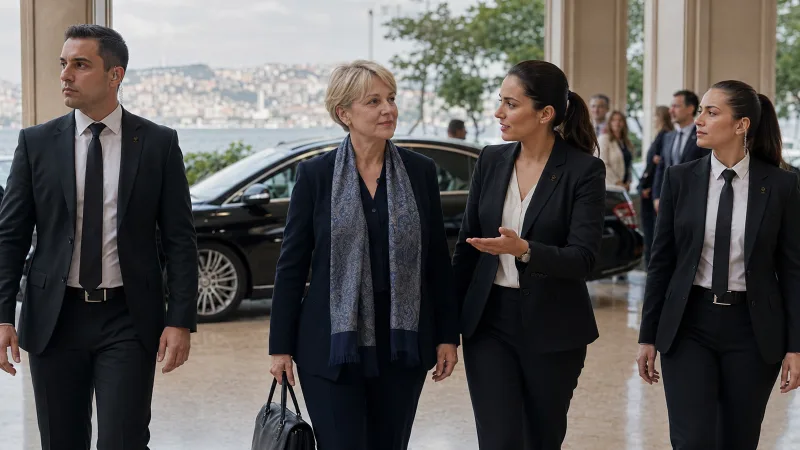
What does Artist, Protocol and Foreign Delegation Protection solve in practice?
An organisation's need for Artist, Protocol and Foreign Delegation Protection is more detailed than the visible precaution. Schedule changes, crowd contact, protocol order, stage or meeting transitions and coordination between organisations are converted into a clear service scope against the principal schedule, public profile, route pattern and privacy expectations. Location, timing, user profile and critical contact points are examined in relation to protection needs assessed together with the individual schedule, public profile, travel pattern and immediate environment. Every duty in the agreement should create an observable field control. Statements that cannot be applied and responsibilities with no owner are removed from the scope.
When an artist moves to stage, a protocol guest enters the hall or a foreign delegation changes vehicles, the venue, organiser, protection team and official parties must share one movement plan. This is where the actual workload appears. At that point the protection officer should act under an approved rule rather than personal interpretation and leave a trace in schedule changes results, crowd contact records, stage or meeting transitions and coordination between organisations verification, incident notices and open corrective actions.
How are Schedule changes managed?
For Artist, Protocol and Foreign Delegation Protection, schedule changes belong in the assignment briefing. Normal conditions, unacceptable deviation and the first action by the protection officer are stated separately. If crowd contact belongs to another team, notification time and transfer method are also specified. Management later confirms delivery through schedule changes results, crowd contact records, stage or meeting transitions and coordination between organisations verification, incident notices and open corrective actions, rather than relying on an informal assurance.
Crowd contact within Artist, Protocol and Foreign Delegation Protection
Within the programme and movement route, crowd contact cannot depend solely on individual experience. Fast judgement from an experienced person matters, but boundaries, notifications and evidence must remain consistent throughout the assignment programme. Assurance for Artist, Protocol and Foreign Delegation Protection looks for that standard in schedule changes results, crowd contact records, stage or meeting transitions and coordination between organisations verification, incident notices and open corrective actions; it examines the information behind a decision as well as the result.
Operational controls for Protocol order
Within Artist, Protocol and Foreign Delegation Protection, protocol order is a distinct decision point with a practical outcome. The protection officer needs to know what information to check, who resolves uncertainty and which record closes the action. If it is not connected to stage or meeting transitions and coordination between organisations, a correct first control can lose value at the following stage. The instruction is therefore written from the real flow in the programme and movement route, not copied from broad wording used for Close Protection and VIP Security.
Stage or meeting transitions and coordination between organisations: a critical duty point
An excessive control for stage or meeting transitions and coordination between organisations can obstruct daily activity, while a weak one leaves hidden exposure. For Artist, Protocol and Foreign Delegation Protection, incident history, movement volume and current authority are used to find the proportionate level. If the rule conflicts with schedule changes, the conflict is resolved before mobilisation and the protection team receives one current instruction.
Failures that weaken Artist, Protocol and Foreign Delegation Protection
A risk list is the beginning of Artist, Protocol and Foreign Delegation Protection planning, not the finished result. predictable routes, uncontrolled contact, information leakage, unplanned transfers and loss of coordination during an emergency are tied to the relevant time, zone, person and dependency. Residual exposure is assessed after confirming that schedule changes, crowd contact, protocol order, stage or meeting transitions and coordination between organisations work in practice. A control written in a document but absent on the shift is not treated as existing.
Before Artist, Protocol and Foreign Delegation Protection goes live, schedule changes, crowd contact, protocol order, stage or meeting transitions and coordination between organisations is checked in the programme and movement route. Peak demand, a change in the assignment programme or technical outage can disprove a desk assumption. Findings create a baseline within schedule changes results, crowd contact records, stage or meeting transitions and coordination between organisations verification, incident notices and open corrective actions; later assurance compares current performance against it. The process stays open until approval enters the Artist, Protocol and Foreign Delegation Protection assignment record.
Building the Artist, Protocol and Foreign Delegation Protection assignment and its records
- Discovery: schedule changes is observed on site, including the current method and known exceptions.
- Design: ownership and information transfer between crowd contact and protocol order are documented.
- Preparation: protection personnel, driver, vehicle, route information and communications plan required for Artist, Protocol and Foreign Delegation Protection are confirmed before launch.
Where Artist, Protocol and Foreign Delegation Protection must start quickly, temporary protection is separated from the permanent model. Immediate exposure is covered while discovery for schedule changes, crowd contact, protocol order, stage or meeting transitions and coordination between organisations continues. Once permanent instructions are issued, old versions are withdrawn and schedule changes results, crowd contact records, stage or meeting transitions and coordination between organisations verification, incident notices and open corrective actions begin the first measured period.
Price alone does not define Artist, Protocol and Foreign Delegation Protection
Provider experience in Artist, Protocol and Foreign Delegation Protection should not remain an unsupported statement. Review the instruction, report example and change process intended for schedule changes, crowd contact, protocol order, stage or meeting transitions and coordination between organisations. Clear agreement on boundaries, client responsibilities, assurance, confidentiality and access to schedule changes results, crowd contact records, stage or meeting transitions and coordination between organisations verification, incident notices and open corrective actions reduces expectation gaps after mobilisation. The Artist, Protocol and Foreign Delegation Protection owner confirms completion from the relevant record.
Points to settle before Artist, Protocol and Foreign Delegation Protection begins
Who owns Schedule changes within Artist, Protocol and Foreign Delegation Protection?
The Artist, Protocol and Foreign Delegation Protection plan assigns schedule changes to a named role. It also identifies the deputy and expected notification time. If crowd contact belongs to another function, security personnel know what information that function needs and when it must be delivered.
What evidence is needed for Crowd contact?
Yes. A material change to crowd contact may affect protocol order and the resource plan. For Artist, Protocol and Foreign Delegation Protection, duration, location and exposure are reviewed. A temporary case can use a short instruction, while permanent change updates this service duty, briefing and assurance measures together.
The first discussion for Artist, Protocol and Foreign Delegation Protection
A useful Artist, Protocol and Foreign Delegation Protection proposal requires basic information about the person, area or asset, daily movement and expected service period. Titanium Security assesses protection needs assessed together with the individual schedule, public profile, travel pattern and immediate environment through its Ankara operating structure. Discovery confirms schedule changes, crowd contact, protocol order, stage or meeting transitions and coordination between organisations, followed by a duty plan that can be monitored through schedule changes results, crowd contact records, stage or meeting transitions and coordination between organisations verification, incident notices and open corrective actions.