


The operating scope of Airport and Transport Hub Security
Airport and Transport Hub Security is a specialist capability used for layered protection for large, multi entrance or technically sensitive facilities where business continuity is critical. The working method and evidence for high passenger flow, sterile areas, baggage and vehicle contact, multi agency coordination and transport continuity are set after examining facility layout, critical zones, vehicle movement and continuity priorities. Scope is not defined only by headcount, equipment quantities or working hours. Daily movement, the person or asset at risk, authority limits and the people who make decisions during an incident must be understood together. A proposal prepared without this information can underestimate field demand and spend resources at the wrong control point.
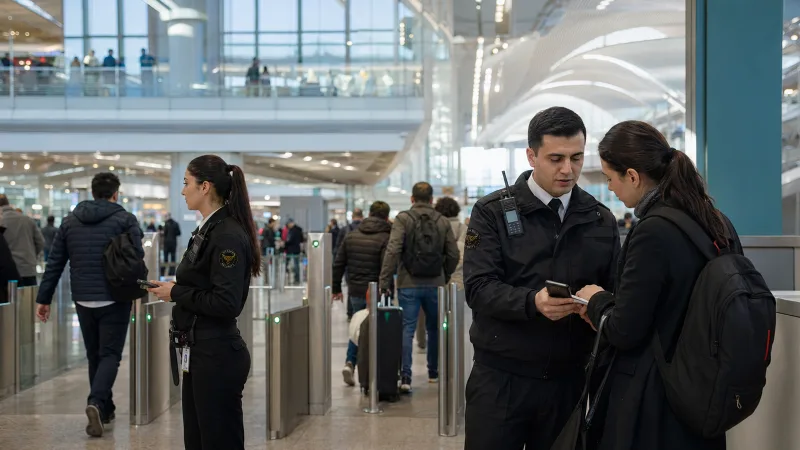
Terminal security operates while passenger flow continues; suspicious items, sterile area breaches and vehicle approaches must be managed without unnecessary transport disruption. This example shows why Airport and Transport Hub Security cannot be defined by a desk-based assessment alone. Decisions made during discovery should later be verifiable through high passenger flow results, sterile areas records, multi agency coordination and transport continuity verification, incident notices and open corrective actions.
How is High passenger flow managed?
Within Airport and Transport Hub Security, high passenger flow is a distinct decision point with a practical outcome. The facility security officer needs to know what information to check, who resolves uncertainty and which record closes the action. If it is not connected to sterile areas, a correct first control can lose value at the following stage. The instruction is therefore written from the real flow in the facility and perimeter, not copied from broad wording used for Facility, Campus and Critical Infrastructure Security.
Sterile areas within Airport and Transport Hub Security
An excessive control for sterile areas can obstruct daily activity, while a weak one leaves hidden exposure. For Airport and Transport Hub Security, incident history, movement volume and current authority are used to find the proportionate level. If the rule conflicts with baggage and vehicle contact, the conflict is resolved before mobilisation and the facility security team receives one current instruction.
Operational controls for Baggage and vehicle contact
The Airport and Transport Hub Security method separates the normal flow from exceptions around baggage and vehicle contact. The routine path stays concise. Suspicion, mismatch or technical failure opens a second, clearly defined path. When multi agency coordination and transport continuity form part of that exception path, the transfer between the two duties is rehearsed on site before full operation.
Multi agency coordination and transport continuity: a critical duty point
Before service begins, multi agency coordination and transport continuity are verified through discussion and observation. The review considers how the current method behaves at peak demand, not merely how it is described. The Airport and Transport Hub Security team must see information needed for high passenger flow in the same chain. Otherwise one of the conditions around perimeter breaches, unauthorised entry to critical areas, sabotage, safety deviations and operational interruption can develop before its origin and owner are understood.
Failures that weaken Airport and Transport Hub Security
Applying the strongest possible measure to every risk is not sound resource use. Discovery for Airport and Transport Hub Security prioritises perimeter breaches, unauthorised entry to critical areas, sabotage, safety deviations and operational interruption through evidence, history and observation. high passenger flow, sterile areas, baggage and vehicle contact, multi agency coordination and transport continuity are directed to higher exposures without slowing low risk daily activity through unnecessary procedures. An open action remains separately visible in the Airport and Transport Hub Security review.
Before Airport and Transport Hub Security goes live, high passenger flow, sterile areas, baggage and vehicle contact, multi agency coordination and transport continuity is checked in the facility and perimeter. Peak demand, a change in the operating shift or technical outage can disprove a desk assumption. Findings create a baseline within high passenger flow results, sterile areas records, multi agency coordination and transport continuity verification, incident notices and open corrective actions; later assurance compares current performance against it.
Building the Airport and Transport Hub Security assignment and its records
- Discovery: high passenger flow is observed on site, including the current method and known exceptions.
- Design: ownership and information transfer between sterile areas and baggage and vehicle contact are documented.
- Preparation: security personnel, patrol vehicle, control devices, site plan and access permissions required for Airport and Transport Hub Security are confirmed before launch.
Mobilisation for Airport and Transport Hub Security begins before personnel arrive on site. The parties agree high passenger flow, sterile areas, baggage and vehicle contact, multi agency coordination and transport continuity, approve instructions and contacts, then prepare the required permissions. After the first shift or assignment, high passenger flow results, sterile areas records, multi agency coordination and transport continuity verification, incident notices and open corrective actions are reviewed and any part of the plan that does not match field reality is corrected. The result is also shown in the Airport and Transport Hub Security assurance record.
Practical questions about Airport and Transport Hub Security
Who owns High passenger flow within Airport and Transport Hub Security?
The Airport and Transport Hub Security plan assigns high passenger flow to a named role. It also identifies the deputy and expected notification time. If sterile areas belong to another function, security personnel know what information that function needs and when it must be delivered.
What evidence is needed for Sterile areas?
Yes. A material change to sterile areas may affect baggage and vehicle contact and the resource plan. For Airport and Transport Hub Security, duration, location and exposure are reviewed. A temporary case can use a short instruction, while permanent change updates this service duty, briefing and assurance measures together.
Planning Airport and Transport Hub Security in Ankara
For an Ankara based Airport and Transport Hub Security request, Titanium Security first reviews location, operating hours, user movement and available incident information. Once the facility and perimeter review required for high passenger flow, sterile areas, baggage and vehicle contact, multi agency coordination and transport continuity is clear, duties, mobilisation and reporting become a specific proposal. The model is not restricted by city and can be adapted to multi-site operations across Türkiye.